
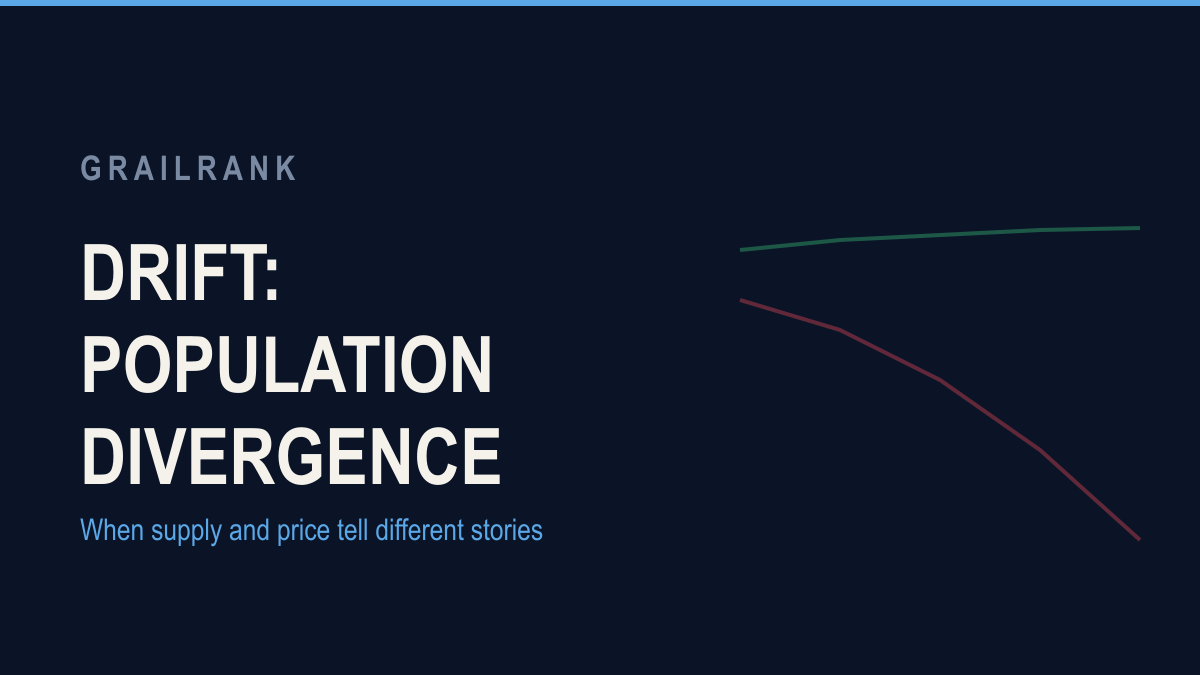
DRIFT is GrailRank's population-divergence signal for graded cards. It compares a card's graded-population growth rate against its price trajectory, week over week. When population grows fast but price holds flat, existing holders are being diluted by new supply. When population plateaus but price rises, the scarcity is real. Price trackers show you one half of this equation; DRIFT shows you both.
Every tool in this hobby shows you a price chart. Almost none of them show you the other half of the market.
Price is demand meeting supply, and the supply side of graded cards is published openly; grading companies update their population census continuously, free for anyone to read. Almost nobody reads it as a signal. Collectors treat the pop report as trivia, a number you check once when you buy. Meanwhile it quietly determines whether the price chart you are staring at is telling the truth.
DRIFT is GrailRank's name for reading both curves at once: the divergence between a card's population growth rate and its price trajectory. This piece explains what the signal means, the four states it can be in, and why it is the closest thing the card market has to float analysis in equities.
The core idea: pop reports are share issuance
A graded card is not a fixed-supply asset. It feels like one (the print run happened years ago, the card is "rare") but the graded supply, the supply that actually trades, grows every time someone submits a raw copy. The population report is a record of ongoing issuance.
Treat it the way an equity analyst treats shares outstanding. A company that doubles its share count has diluted every existing holder, whatever the stock price did that week. A card whose PSA 10 population grows 40% while its price holds flat has run the same operation on its holders: silently, in public, one submission at a time.
Price alone cannot show you this. A flat price chart looks like stability. Against a surging population, the same flat chart is absorption: new supply being soaked up at a constant price until, one day, it isn't.
The four quadrants
Every card sits in one of four states at any moment. The information content is different in each.
Population rising, price rising. Momentum. Attention is pulling raw copies into the grading queue and demand is outrunning the new supply, for now. This is where tournament hype and viral moments live. The question to ask: is the price rising faster than the population, or is the rally racing its own dilution? The steeper the population curve, the shorter the runway.
Population rising, price flat or falling. Bearish divergence. This is the dilution quadrant, and it is the single most common way collectors lose money slowly. The card looks "stable" on every price tracker while its supply compounds underneath. By the time the price chart confirms the problem, the population already did, weeks earlier.
Population flat, price rising. Bullish divergence. Demand is repricing a supply that is not growing: the raw copies are exhausted, or the grading wave for that card already happened years ago. This is genuine scarcity being discovered, and it is the most durable form of price strength in the hobby.
Population flat, price flat. Dormant. No signal, no story. Most of the catalog lives here, and that is fine; dormant is not bad, it is just quiet. The interesting moment is when a dormant card wakes up in one direction without the other following.
What it looks like in real cards
The 2024 Panini Prizm Copa America Lamine Yamal carries a graded population around 2,100, and growing. Yamal is a generational talent and the card has real demand, but every week's submissions add copies, and every new gem mint slab competes with every existing one. Whatever the price does this summer, the population curve is the context it has to be read against.
Now the opposite pole: the 2003 Topps Chrome UEFA Cristiano Ronaldo Superfractor 1/1 in PSA 10: population 4. The supply side of that market is structurally frozen. There is no raw copy waiting in a binder, no grading wave coming. Every dollar of price movement is pure demand signal, undiluted. That is why a card like this sits at the top of the market cap rankings on a population most modern cards exceed in a week.
And the extreme case for scale: the Charizard ex from Pokémon Scarlet & Violet 151 carries a total graded population above 100,000, with roughly 29,500 of those in gem mint, figures straight from the weekly population snapshots in the GrailRank DRIFT feed. A card can be iconic, liquid, and beloved while minting new supply at industrial volume. Population data is the only way to see which of those properties you are actually paying for.
How GrailRank computes it
Every week, GrailRank captures population snapshots across soccer, Pokémon, and MTG, alongside price snapshots for the same cards. The divergence between the two curves is computed per card and surfaced three ways:
- The DRIFT dashboard on the front page charts population against price for the most-watched cards, updated weekly. - Per-card pages show each card's population, market cap, and rank side by side, recomputed daily. - The weekly movers digest lists the strongest published signals, including drift, across all three verticals, every week.
Honest limitations, because a signal you can't audit is just marketing. Population reports lag reality: a card sitting in a grading queue is future supply that no census shows yet. Crossovers and crack-and-resubmit cycles can double-count copies. And divergence is a leading indicator, not a verdict: population pressure tells you which way the structural wind is blowing, not the date the weather changes.
Price is the rumor. Population is the record.
The card market has spent years building better and better price trackers while the supply data sat in public, unread. DRIFT exists because the two curves only mean something together: a price chart without its population curve is half a sentence.
If market cap is the metric that tells you what a card is, DRIFT is the metric that tells you where it's going structurally. Neither is financial advice; they are measurements. But between a collector who reads both curves and one who reads only price, the first one is trading on the whole market and the second is trading on half of it.
Frequently Asked Questions
What is a DRIFT signal in card collecting?
A DRIFT signal measures the divergence between a card's graded-population growth rate and its price trajectory. Grading companies publish population reports weekly, and prices are recorded with every sale. When the two move in opposite directions (population surging while price stalls, or price rising while population stays flat), that divergence carries information that neither number shows on its own.
Why does graded population growth lower card values?
Every raw copy that gets graded adds supply at that grade. A card whose PSA 10 population doubles has twice as many copies competing for the same buyers, which works exactly like share issuance diluting stockholders. Price can hold up for a while on attention, but a growing population is a structural headwind that eventually shows up in the comps.
How do I check if a card's population is growing too fast?
Compare population snapshots over time rather than looking at a single number. Grading companies publish census data, and GrailRank captures weekly population snapshots across soccer, Pokémon, and MTG, then charts them against price on the DRIFT dashboard. A population curve that is steeper than the price curve is the warning sign.
What is a bullish population divergence?
Population flat, price rising. It means demand is growing against a supply that is not: either the raw copies are exhausted, or the card is old enough that the grading wave already happened. That is genuine scarcity being repriced, and it is the most durable kind of price strength a graded card can show.
How is DRIFT different from a price tracker?
A price tracker tells you what the last copy sold for. DRIFT tells you whether the supply behind that price is expanding or fixed. Two cards with identical price charts can be opposite positions: one with a frozen population and one minting new graded copies every week. Price trackers cannot distinguish them. DRIFT exists to make that distinction visible.